
The Grey Swan Takes Flight
Reimagining Truth and Power in the Age of Social Platforms

The Grey Swan Takes Flight: Active Inference and Geometric Metacognition as Truth Engines in Social Media’s Regime of Power
Reimagining Truth and Power in the Age of Social Platforms
Introduction
Social media was once heralded as a democratizing force - - a global agora where truth could flourish. Today, it resembles a Foucauldian labyrinth: a space where “truth” is less an objective constant and more an effect of power, discourse, and performance. Visibility and engagement - - not veracity - - define credibility. In this regime, influencer marketing and algorithmic governance blur the line between authentic expression and commercial ploy.
If truth is contingent, can technology help us reclaim it?
Enter Active Inference and Geometric Metacognition (GMC) - - two cognitive architectures that promise to rewire the epistemic infrastructure of social media.
The Foucauldian Landscape of Social Media
Michel Foucault argued that truth is not discovered but produced—a construct of prevailing discourses and institutional power. On social platforms:
- Power/Knowledge: Those who control algorithms and narratives shape what counts as credible knowledge.
- Fragmented Discourses: Scientific, journalistic, commercial, and identity-driven narratives collide, creating epistemic turbulence.
- Panopticism: Users are both observers and observed, curating online personas under constant self-surveillance to gain social capital.
In this environment, even “authentic” content often serves a marketing function. Influencers confess intimate details to accumulate followers, practicing a modern form of Foucault’s theory of confession. Strategic authenticity becomes a commodity.
If the channel is permitted to propagate falsehoods, the extreme mechanistic nature of the information network lets it move faster than we can possibly regulate via familiar methods of governance. We must use our understanding of the flaws in current channels of data migration and our studies of subjective, predictive technologies to build an effective, technically advanced line of defense against fictional, illogical or immoral influence.
While embracing the promise of a new order, there remains an immediate need to insure the transition from the old order to the new is ethically reliable.
Why Traditional Fact-Checking Fails
Fact-checking assumes a static truth model. But social media is dynamic, identity-driven, and performative. Truth claims mutate as discourses shift. Binary labels—true or false—collapse under the weight of context, emotion, and algorithmic amplification.
What we need is not a static arbiter of truth but a living epistemic engine—one that adapts to uncertainty, evaluates confidence, and resists manipulation by power asymmetries.
Active Inference: A Dynamic Truth Framework
Active Inference, rooted in Bayesian principles, models cognition as a process of minimizing surprise (or free energy). Agents continuously update beliefs to align predictions with sensory evidence.
Applied to social media:
- Dynamic Evidence Integration: Truth engines can infer probabilistic states of claims, weighting evidence as new data emerges.
- Beyond Binary: Instead of labeling content as true or false, Active Inference supports graded truth states that reflect evolving contexts.
- Resilience to Manipulation: By modeling uncertainty explicitly, the system resists epistemic capture by dominant narratives.
Geometric Metacognition: The Epistemic Compass
If Active Inference is the engine, GMC is the steering system. GMC provides a higher-order structure for evaluating confidence across multidimensional contexts.
- Meta-Evaluation: GMC assesses not just what we believe, but how confident we are in those beliefs.
- Truth Geometry: Imagine mapping claims in a multidimensional space—where distance reflects epistemic similarity, and curvature encodes uncertainty.
- Adaptive Governance: GMC enables systems to recalibrate confidence as discourses evolve, creating a truth topology that is transparent and dynamic.
Visualizing the Future: Picture a Truth Topology Map
- Nodes = claims.
- Edges = discourse influence.
- Color gradients = confidence levels derived from GMC.
- Dynamic updates as new evidence enters the system.
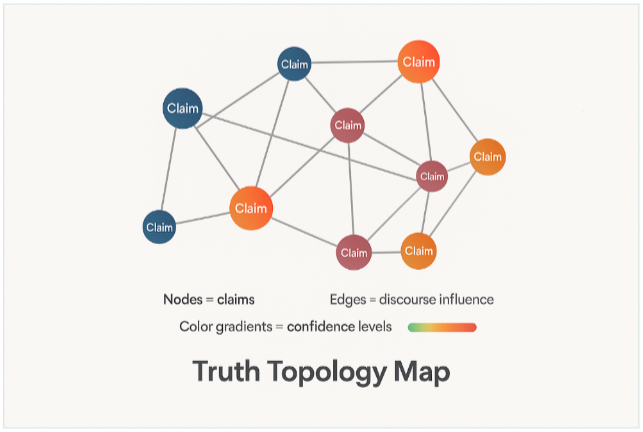
The Truth Topology Map is important because it provides a visual and intuitive framework for understanding how claims relate to each other within a complex discourse. By mapping nodes as claims and using edges to represent discourse influence, the topology makes it easier to trace how information spreads and evolves. The color gradients, which reflect confidence levels derived from GMC, help users quickly gauge the reliability and uncertainty of each claim, facilitating more informed decision-making.
Furthermore, the dynamic nature of the topology allows for real-time updates as new evidence emerges, ensuring that the map remains an accurate reflection of the current epistemic landscape. This transparency is essential for adaptive governance, as it enables systems and users to recalibrate confidence and trust as discussions progress, ultimately supporting resilience against misinformation and fostering a more nuanced understanding of truth.
Designing a Source of Truth
Implementing this source of truth on social media platforms like X, Facebook, and Truth Social would fundamentally transform how information is evaluated and consumed. By incorporating dynamic evidence integration and probabilistic truth scoring, these platforms could provide users with nuanced assessments of claims, moving beyond simplistic true/false labels. The Epistemic Transparency Dashboard would allow users to view confidence gradients and uncertainty metrics, empowering them to make more informed judgments about the content they encounter.
Additionally, features like Influence Vector Analysis would help identify and mitigate the influence of algorithmic bias and power asymmetries, promoting a more balanced discourse. Adaptive governance protocols would ensure that ethical principles are embedded in content evaluation, helping to prevent manipulation and epistemic capture. Overall, these advancements would foster greater trust, resilience to misinformation, and adaptability in the ever-evolving landscape of social media.
Features
- Dynamic Truth Scoring: Real-time probabilistic evaluation of claims across fragmented discourses.
- Epistemic Transparency Dashboard: Displays confidence gradients and uncertainty metrics for end-users.
- Influence Vector Analysis: Detects power asymmetries and algorithmic bias in narrative propagation.
- Adaptive Governance Protocols: Embeds ethical principles into inferenceloops to prevent epistemic capture.
- Multi-Modal Integration: Processes text, image, and video signals for holistic truth estimation.
Benefits
- Resilience to Manipulation: Probabilistic truth states and confidence calibration reduce susceptibility to misinformation campaigns.
- Context-Aware Adaptation: System evolves with discourse shifts, outperforming static fact-checking models.
- Enhanced Trust: Transparent uncertainty metrics foster user confidence without oversimplifying complexity.
- Strategic Insight for Enterprises: Enables organizations to monitor epistemic integrity in influencer marketing and brand narratives.
- Scalable Governance: Supports ethical oversight through agentic AI modules that align with regulatory frameworks.
Financial Implications for Social Platforms
Why does this matter economically? Implementing a Truth Engine built on Prodigii AI’s Active Inference + Geometric Metacognition would reshape the economics of social media.
Current Monetization
- X (Twitter): Relies heavily on advertising and paid verification subscriptions (X Premium). Verification has become a revenue stream, but its credibility erosion risks user trust and advertiser confidence.
- Facebook (Meta): Dominates ad revenue through engagement-driven algorithms. Paid verification (Meta Verified) adds incremental subscription income but does not significantly offset ad dependency.
- Truth Social: Primarily ad-based, with IPO valuation peaking near $8B but revenue remains minimal ($837K in Q2 2024 vs $16M loss). Its financial health is tied to political cycles, making diversification critical.
Cost Considerations
- Initial deployment may range from $600K–$1.5M per platform, plus ongoing operational and governance costs.
Short-Term Impact
- Platforms like X, Facebook, and Truth Social may see a temporary dip in engagement as misinformation and bot-driven activity are curtailed. This could reduce ad impressions and lower CPM-based revenue in the near term.
ROI Drivers
- Reduced Legal Risk: Truth engines mitigate misinformation-related lawsuits and regulatory penalties, which can cost platforms tens of millions.
- Premium Subscription Upsell: Verified truth scores could become a tiered feature, creating new subscription revenue streams (similar to X Premium but credibility-based).
- Advertiser Confidence: Enhanced brand safety could recover 10–15% of lost ad spend from sectors avoiding high-risk environments.
Strategic Benefits
- Market Differentiation: Platforms adopting truth engines early can position themselves as trust-centric ecosystems, attracting institutional advertisers and government partnerships.
- User Retention: Transparency dashboards and confidence metrics foster loyalty among high-value users (journalists, professionals).
- New Monetization Models: Truth-as-a-Service APIs for enterprises and media outlets could generate $50M+ annually in additional revenues for large platforms.
Bottom Line
While engagement-driven revenue may dip initially, platforms that adopt truth engines early can unlock sustainable growth through trust-driven monetization and premium advertising partnerships.
Conclusion
Social media’s regime of truth thrives on visibility, engagement, and capital. By embedding Active Inference and Geometric Metacognition into its infrastructure, we can shift from visibility-driven truth to inference-driven truth—a future where epistemic integrity is not an accident but an architecture.
Our Truth Engine is not just a technical artifact - - it’s a philosophical intervention. A Grey Swan moment: low-probability, high-impact innovation that rewires the epistemic DNA of social media.
Now is the time to take decisive action.
Join us in pioneering a new standard for digital truth—whether you’re a platform executive, policymaker, or concerned user, your commitment can help transform the future of online discourse.
Let's work together to build a social media landscape grounded in trust, transparency, and genuine integrity.
